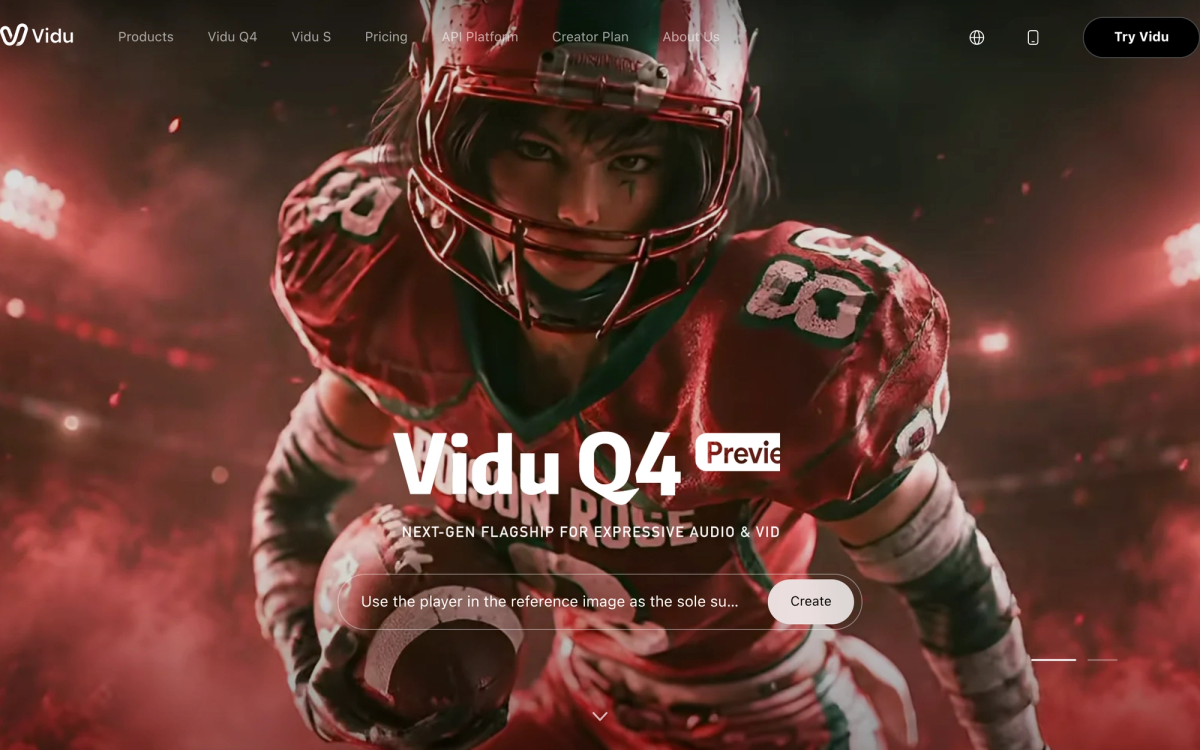
Last updated: October 10, 2026. Shengshu Technology launched Vidu Q4 Preview on October 7, 2026 — the first public taste of its next flagship video model, with synchronized native audio, up to 15 image references, and 4K 10-bit output. It entered third on Artificial Analysis's image-to-video leaderboard within days. Here is everything verified so far, including a pricing story that is stranger than it should be.
What is Vidu Q4 Preview?
Q4 Preview is a public preview of Vidu's next-generation flagship model, released ahead of the final Q4 so creators can use it on real projects and shape the final build. It emphasizes lifelike character performance, cinematic camera language, complex effects and voice-consistent characters. The full Q4 model has no announced date.
Features and limits
- Image-to-Video — one image plus a prompt, 3–16 seconds
- Reference-to-Video — up to 15 image references (characters, wardrobe, props, products, environments) plus up to 3 reference audio clips to hold a voice consistent across a scene; 1–16 seconds
- Native audio — synchronized dialogue and sound effects generated with the video
- Resolution — 540p / 720p / 1080p / 2K / 4K, with 10-bit color at higher tiers, 24fps
- Not in the preview — text-to-video and first-and-last-frame endpoints are not documented yet; start from an image
Pricing: two official numbers
Vidu's two same-day press releases disagree. One quotes launch pricing starting at $0.014 per second; the other states $0.045 per second at 540p, scaling to $0.39 per second at 4K. The 30% launch promotion (through November 30, 2026) does not reconcile the two. The official API rate card in RMB — 0.03125 per credit — implies roughly ¥0.75/second at 1080p and ¥2.44/second at 4K for a 10-second clip.
Practical takeaway: treat any Vidu Q4 Preview cost estimate this month as provisional, and check your account's actual billing before batch-rendering. The cheapest honest statement is that it costs somewhere between $0.014 and $0.39 per second depending on resolution, plan, region and calendar.
Benchmarks: third on day one
Third-party placements on Artificial Analysis's image-to-video leaderboard put Vidu Q4 Preview at an Elo of 1,179 — third overall, and far ahead of the older Vidu Q3 Pro (1,056). Shengshu also claims up to 5x more output for the same budget versus comparable conditions, though it does not name the comparison model. CEO Yihang Luo's launch framing: 'Advanced video models should prove themselves beyond carefully selected demos.'
Vidu Q4 Preview vs Seedance 2.5 vs Kling
vs Seedance 2.5 — ByteDance's model generates 30-second native clips with extensions and up to 50 multimodal references; Vidu Q4 Preview counters with 15-image plus 3-audio references, 4K 10-bit, and aggressive launch pricing. See our Seedance 2.5 listing for the full breakdown.
Against Kling, Vidu's differentiators are multi-reference character and voice consistency at 4K, and an API that exposes audio references directly. Kling remains strong on motion quality and mature tooling.
How to use it
The preview runs through Vidu's web product and the Vidu API. The API model ID is viduq4-preview — don't substitute guessed IDs like vidu-q4. Documented endpoints: /ent/v2/img2video (image-to-video) and /ent/v2/reference2video (reference-to-video with 1–15 images and 0–3 MP3 audio references, each 3–12 seconds).
We track it in the directory here: Vidu Q4 Preview.
FAQ
When does the full Vidu Q4 release?
No announced date. The preview exists precisely to gather creator feedback before the final build — expect the final release after that feedback cycle.
How much does Vidu Q4 Preview cost?
Officially: either $0.014/second or $0.045/second at 540p depending on which press release you read, with a 30% discount through November 30, 2026, and up to $0.39/second at 4K. Verify against the rate card in your account.
Can Vidu Q4 Preview do text-to-video?
Not in the preview. Only image-to-video and reference-to-video endpoints are documented — start from an image.
Is it good for consistent characters?
That is the headline feature: up to 15 image references lock subjects and environments, and up to 3 audio references keep a character's voice consistent across scenes — useful for series and ad work.
Related reading: launching the same season, Qwen-Image 2.1 is Alibaba's open-source answer for image generation and editing — see how the open-weights side of the AI stack is evolving.